
Nepal’s Economic Crossroads: Navigating Risk, Reform and Regional Pressures

Nepal’s economic trajectory is increasingly shaped by the intersection of domestic policy uncertainty and external vulnerability. The country’s structural constraints, ranging from import dependence to limited industrial capacity, continue to amplify the impact of global shocks.
As a net importer of petroleum products, Nepal remains highly exposed to price volatility stemming from events such as the Russia-Ukraine war and geopolitical tensions in the Middle East. These pressures transmit directly into inflation and external sector imbalances, compounded by supply chain disruptions and currency depreciation.
At the same time, remittance inflows continue to play a stabilising role, supporting consumption and foreign exchange reserves. However, their dominance also reflects a structural imbalance, with insufficient progress toward export diversification and industrial expansion. Persistent trade deficits highlight Nepal’s weak global competitiveness and the slow pace of its transition toward a production-driven economy.
Geographically positioned between India and China, Nepal operates within a complex regional dynamic that requires strategic economic alignment. Domestically, frequent political transitions have raised concerns about policy consistency, regulatory predictability and reform execution.
The central policy challenge remains clear: can Nepal translate macroeconomic stability into sustained structural transformation?
In this Opinion segment, we gather insights from Rtd Brigadier General Keshar Bahadur Bhandari, PhD; Dr Neelam Dhungana Timsina, Former Senior Deputy Governor, Nepal Rastra Bank; and Ram Narayan Shrestha, PhD, Assistant Professor (Economics), Kathmandu University School of Management.

Keshar Bahadur Bhandari, PhD, Rtd Brigadier General
With Nepal’s recent government changes, how do you see policy continuity, or disruption, affecting investor confidence and the country’s ability to execute long-term economic strategy?
Keshar Bahadur Bhandari: It seems that there will be a change in policy continuity. If the policy changes come about in a pragmatic way, it will have a positive effect in boosting investor confidence. This, in turn, would support the design and execution of a long-term economic strategy.
Neelam Dhungana Timsina: Policy continuity is less a slogan to me and more of an operating discipline. Investors do not expect all governments to think uniformly. Rather, they expect contracts to be upheld, macroeconomic regulations to be intelligible and project decisions to outlive changes in administration. We anticipate that Nepal has emerged from a period of political instability and is now moving toward lasting stability.
According to the World Bank, there was a 3.4% economic growth in the first half of Fiscal Year 2025/26 with smaller investment (y-o-y) growth, and due to the Gen Z movement, an economic loss of about 1.3% of GDP was estimated. So, a change of leadership can be a reset or a setback. It would be a reset if the new government focuses more on predictability in the policies, makes tax administration less cumbersome, accelerates the approval of infrastructural projects, and minimises corruption and discretion in regulation. Strategically, Nepal cannot achieve a long-term economic change just within a year. Hydropower, tourism, logistics, digital services and industrial upgradation are not something that should be promoted in a single budget cycle. Whether there has been a change in government is, really, not the question, but whether the state can maintain a plausible medium-term economic path under varying political regimes is the main issue.
Ram Narayan Shrestha: The ‘100-point roadmap’ presented by the government offers the first credible signal. A careful reading suggests that many of its reform agendas are continuations of earlier ones. It appears that the government will continue the broad economic approach of earlier governments, with a shift toward delivery-based governance by emphasising a results-based (delivery/KPI-driven) framework.
While the Constitution of Nepal focuses on ‘socialism-oriented’ economic philosophy, the economic policy practice of successive governments generally leaned toward a liberal, market-oriented model, with different parties applying it with varying intensity and different distributional priorities. The policy orientation of the present government also seems to move towards this. However, the degree to which it will prioritise liberal economic principles is still to be seen. For investors, both domestic businesses and foreign private sector participants, this moment carries cautious optimism alongside legitimate curiosity about whether better policy outcomes will follow. For now, what the government clearly possesses is the mandate to execute a long-term economic strategy. The test ahead is whether that mandate can be translated into durable institutional change that outlasts any single government.
As a net oil importer, Nepal remains highly exposed to global price volatility driven by conflicts like the Russia-Ukraine war and Middle East tensions. What structural reforms are most urgent to reduce this energy vulnerability?
Keshar Bahadur Bhandari: The countries in the present world are interdependent, and none is totally self-sufficient. The wars mentioned above, and the recent war between the USA, Israel and Iran have affected the global economy, and Nepal is indeed one of them. Therefore, the most urgent policy and structural reform needed is to generate more hydropower electricity and make maximum use of the same to reduce dependency on hydrocarbon products.
Neelam Dhungana Timsina: We are all aware that the vulnerability of oil in Nepal is not simply a matter of price, but a matter of structural dependency. The extensive dependence of Nepal on imported refined petroleum products through India and the fact that this supply chain is still firmly connected with the markets of the Middle East increases the vulnerability to external fluctuations of the prices in the global markets. The immediate reform is energy substitution. Nepal needs to speed up the transition from imported petroleum products to the consumption of domestic electricity wherever possible, particularly in transport, domestic consumption of energy, and industrial processes. The good news is that we are moving towards a transition.
According to the World Bank, as of the end of 2024, the installed hydropower capacity was approximately 2,990 MW, and almost 385 MW were to be further added in the first half of FY 2025/26 alone. However, only the generation of hydropower is not enough. First, we must focus on transmission expansion, enhance the reliability of power distribution across the border, cross-border power trade, electric mobility infrastructures, and a stable tariff regime of electricity. Secondly, we can focus on improving fuel security control by enhancing storage, focusing on a transparent oil price formula, and on contingency measures to facilitate passenger transport and aviation inconvenience whenever we face a fuel crisis. Simply, resilience is not going to rise through subsidising petroleum products in the long run. Resilience rises through lessening the dependency on petroleum products.
Ram Narayan Shrestha: Energy is the backbone of any economy. As Nepal seeks higher growth, energy use will rise, making energy security essential for sustained development. The challenge is to reduce structural exposure to global price volatility, shaped by conflicts such as the Russia-Ukraine war and tensions in West Asia, while meeting growing demand.
In the short term, Nepal must coordinate closely with existing suppliers to ensure uninterrupted fuel flows, especially since nearly all petroleum imports come through a single corridor. Demand-side measures are also important. The two-day weekend policy is one example but its actual fuel-saving impact should be assessed so similar efforts can be better designed. Maintaining adequate buffer stocks to absorb shocks and strengthening market monitoring to prevent black marketing and hoarding during shortages are steps the government can take immediately.
Over the medium to long term, the focus should shift to structural efficiency and substitution. Upgrading transmission and distribution systems to reduce losses, expanding hydropower, and integrating solar energy into the grid are already underway and need greater urgency. Cutting technical and commercial losses alone can expand usable supply without a new generation. Electric vehicle adoption offers a direct way to reduce petroleum dependence, but it depends on better charging networks, stable pricing policies and stronger domestic maintenance services.
From supply chain disruptions to rising inflation, global conflicts are reshaping smaller economies. How prepared is Nepal to absorb prolonged geopolitical shocks without derailing growth?
Keshar Bahadur Bhandari: Nepal has no choice but to be prepared to absorb geopolitical shocks brought by global conflicts and their effects. A few policy changes Nepal should bring are to encourage developing and producing of basic goods and services. The aim is to be self-sufficient at least in food products. The government must utilise available resources optimally to support growth.
Neelam Dhungana Timsina: If we see the status of the economic situation, Nepal is seen to be better prepared than before, but it would be risky to say the country is fully protected. The good news is that our external position is strong. The current account surplus has reached 6.7% of GDP in the first half of FY 2025/26, and reserves have risen to $22.5 billion by mid-January 2026. NRB’s eight-month data show reserves climbed further to $23.08 billion by mid-March 2026, while remittances increased by 37.7% and exports by 20.8% in the first eight months of FY 2025/26. These are our real shock absorbers.
But the thing is, we should not get confused about a cushion with immunity. If global conflict continues for a long time, Nepal will receive a stronger blow through the further rise in fuel prices, fertiliser costs, aviation charges, tourism demand, and even labour conditions can worsen in destination countries, which can lead to a decrease in remittance inflow. So, I think that Nepal can handle a shock of short duration but a long geopolitical crisis would test the economy much more seriously. Our buffers can buy time but they cannot replace stronger production, energy security and better policy execution. However, the latest signal seems to be positive. Iran’s April 17 statement on keeping the Strait of Hormuz open has already pushed oil prices down, so the immediate pressure on Nepal’s fuel prices is likely to soften. So, fingers crossed for now.
Ram Narayan Shrestha: Given the uncertain and rapidly evolving nature of today’s geopolitical landscape, it is difficult to predict how prolonged global conflicts will unfold or how their second- and third-order effects will impact economies like ours. This uncertainty itself is an important point. It demands a rethinking of how small, import-dependent economies like Nepal prepare for shocks whose shape is not yet fully visible. As many analysts have rightly argued, maintaining geopolitical balance is one of the most important structural factors for Nepal, given our geography, our trade dependence, and the extent to which our labour and remittance flows are tied to regions that are themselves increasingly unstable. For Nepal, given our high import dependence, narrow export base, heavy reliance on remittances from the Gulf and Malaysia, and the concentration of our fuel supply through a single corridor, the transmission channels of these global shocks are many and mutually reinforcing.
The concerning observation is that much of the preparation needed to cushion these shocks is not yet visible in Nepal’s policy response. The 100-point agenda does mention an inter-ministerial task force on West Asia impact assessment but beyond this, there is no comprehensive contingency framework covering the full spectrum of vulnerabilities, including fuel, food, foreign exchange, remittance disruption, return migration, shipping costs and fertiliser imports, etc, each of which can be individually triggered by different geopolitical scenarios. Nepal’s ability to absorb prolonged geopolitical shocks without derailing growth will depend less on avoiding the shocks themselves, which are largely outside our control, and more on how systematically we prepare the domestic buffers, institutional flexibility, and diversification strategies that determine whether an external shock becomes a manageable disturbance or a full-scale crisis. At present, this preparation is the most significant gap in Nepal’s current policy conversation, and closing it should be treated with the same urgency as the visible governance reform agenda.
In an era of intensifying rivalry between India and China, how effectively is Nepal leveraging economic diplomacy to secure a strategic advantage rather than being constrained by geography?
Keshar Bahadur Bhandari: The hand-sight rivalry between India and China is mainly confined to the defence and military front. On the other hand, the economic engagement between the two countries is growing every year. The economic interest may outweigh the military interests and rivalry for the greater national interests of each other. Nepal maintains the best of relations with both China and India, and it is in an advantageous geo-political position. Hence, Nepal could play a role as a linchpin in bringing India and China closer to cooperate and corroborate for greater economic and aspirational national interests. The kind of economic diplomacy that Nepal could play would be to become a vibrant bridge between India and China, and this would bring strategic advantage not only to Nepal but to the region as a whole.
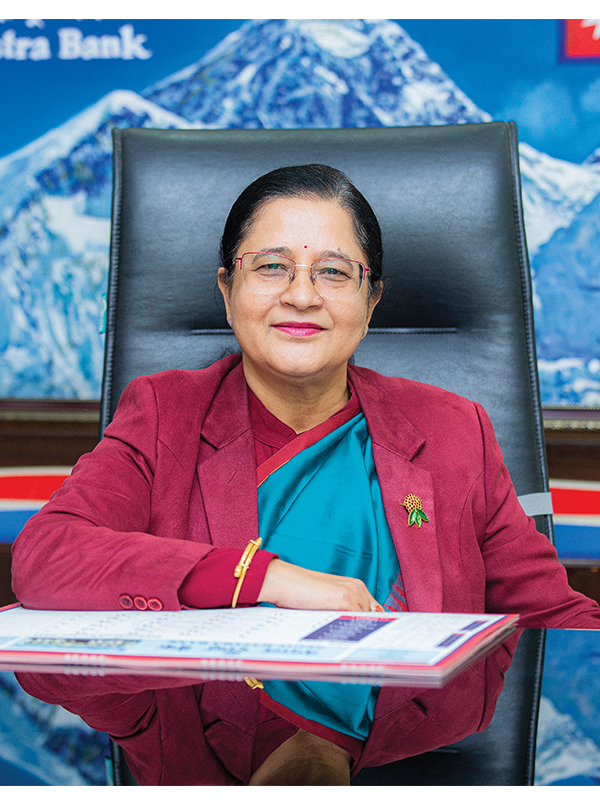
Neelam Dhungana Timsina, Former Senior Deputy Governor, Nepal Rastra Bank
Neelam Dhungana Timsina: Good question. You see, Nepal’s geography should be seen as an advantage, not as a permanent excuse. Being located between India and China gives Nepal a rare economic opportunity. But geography alone does not create benefits. It becomes useful only when the country can turn location into trade, power exchange, tourism, transport links and investment confidence. In my view, Nepal has used economic diplomacy reasonably well in some sectors, especially in the sector of cross-border electricity trade and connectivity discussions.
However, Nepal’s bigger problem is policy implementation at the right time. We often make the right commitments but we are kind of weak in execution. And investors do not judge Nepal only by foreign policy statements. They look at whether approvals are fast, contracts are honoured, customs are efficient and policies remain stable after governments change. In this context, the World Bank has also stressed that the new government has a chance to improve predictability, simplify tax administration, reduce corruption and speed up infrastructure delivery. So, I would say Nepal’s diplomatic space is real but still underused. We need practical diplomacy backed by credible domestic institutions. Overall, I think a small country like ours gains respect when it is reliable, commercially relevant and clear about its economic priorities.
Ram Narayan Shrestha: The global landscape is shifting toward a more multipolar order and while its final shape is uncertain, it is clear that India and China will remain major powers. Nepal sits between them, not just geographically but economically and strategically. This position can be an opportunity if approached with preparation and confidence, rather than seen only as a limitation. Nepal has real potential to benefit from stronger economic diplomacy with its neighbours but progress has often been held back by its own lack of preparation. Too often, negotiations are reactive, with unclear priorities, limited sector-specific data and little continuity across governments. This weakens Nepal’s position and creates a gap between what it aims for and what it can actually deliver.
The opportunity is significant. Proximity to two of the world’s largest economies should naturally bring advantages but Nepal has yet to fully capture them. Economic diplomacy needs to move beyond formalities and become a core area of reform. Instead of trying to compete directly with India and China, Nepal can find its place within their value chains through sectors like hydropower, agriculture, herbal products, IT services, tourism, wellness and light manufacturing. This effort should not rest on the government alone. The private sector must play a central role through partnerships, business networks and cross-border collaboration. Many barriers are due to a lack of information and stronger cooperation can help Nepali businesses engage more confidently with regional markets.
Given Nepal’s persistent trade deficit and heavy reliance on imports, do you see a realistic pathway toward export competitiveness, or will geopolitical realities continue to reinforce structural imbalances?
Keshar Bahadur Bhandari: Nepal must explore potential avenues to develop and produce export-oriented goods and services. Cultivating skilled human resources, focusing on religious, cultural and adventure tourism, manufacturing selective export items, and exporting hydroelectricity offer a realistic pathway toward competitiveness. Achieving this requires recalibrated strategic planning to effectively overcome existing structural imbalances.
Neelam Dhungana Timsina: For this case, I would say, yes, we have a realistic path, but it will take certain discipline and a degree of patience as well. Nepal’s trade deficit is not just due to the result of high imports. It depicts a deeper problem. The bitter truth is, we do not produce enough competitive and strategic goods and services.
World Bank’s Country Economic Memorandum also tells that Nepal’s exports have contributed little to growth for many years because of weak competitiveness, high trade costs, an appreciating real exchange rate, and problems in logistics and transport. That means the answer is not simply to streamline imports. The real answer is to build export capacity. Amongst many that we discuss, hydropower is one of the major opportunities. Tourism can also do better if Nepal focuses on quality, connectivity and spending per visitor rather than only on arrival numbers. Information technology services are another promising area. We already know that geography and geopolitics will continue to shape trade patterns, especially because Nepal depends heavily on India for trade. But geopolitics simply is not destiny. With better logistics, stable policy, reliable power, and stronger export promotion, Nepal can improve its trade position step by step.
Ram Narayan Shrestha: Nepal’s manufacturing landscape presents a difficult reality. When compared to the scale, efficiency and productivity of neighbours like India and China, competing broadly in exports can feel out of reach. Trying to match them in mass manufacturing, heavy industry, or consumer electronics is not a practical strategy in the near term. Framing the challenge this way often leads to discouragement rather than clear direction.
A more realistic path lies in focusing on areas where Nepal already holds natural advantages. Tourism stands out, especially in higher-value segments such as wellness, adventure and cultural experiences that draw on the country’s unique identity. High-value agriculture also offers promise, including organic goods, medicinal and aromatic plants, niche crops, and specialty tea and coffee. Hydropower exports, IT and IT-enabled services, and selective light manufacturing linked to regional supply chains are other viable options. These sectors succeed because they build on Nepal’s geography, biodiversity, cultural richness and a young, adaptable workforce.
However, identifying these opportunities is only the beginning. To truly compete, Nepal must strengthen the systems around it, including reliable supply chains, better logistics, cold storage, quality certification and easier access to finance. At present, high costs remain a major barrier. Industrial land is expensive, energy supply can be unreliable, and labour costs often exceed productivity. Without addressing these structural challenges through consistent and focused industrial policy, even promising sectors will struggle to grow and compete effectively.
With remittances forming a significant share of GDP, is Nepal at risk of postponing deeper economic reforms, and how can policymakers transition from a remittance-driven model to a production- and investment-led economy?
Keshar Bahadur Bhandari: Even during unusual periods of conflict and war, remittance flows continue to grow. In the post-US, Israel-Iran war landscape, the prospect for remittance growth will likely improve due to necessary reconstruction and postwar projects. Policymakers should develop investment plans so that a percentage of received remittances is channelled into national development projects by making contributors active stakeholders and shareholders.
Neelam Dhungana Timsina: Indeed, there is such a risk. Remittances have helped Nepal greatly but they can also make governments less urgent to care about reforms. Remittance supports consumption, reduces poverty and strengthens the external sector. Remittance inflows rose by 37.7% in the first eight months of FY 2025/26, and that has clearly helped reserves and household demand. If we see the NLSS 2022/23, around 71.4% of remittance has been expended for household consumption, however, only 1.2% for capital formation. But no country can build long-term prosperity mainly on migration income.
The real issue is whether remittances are treated as a bridge or as a model. And, in my view, they should be treated as a bridge. A remittance-led economy can support families, but it cannot, on its own, create enough productive jobs, raise technology, or improve industrial capability. That is why Nepal now needs a deliberate shift toward investment and production. In practical terms, policymakers should focus on three important things. First, they should reduce the cost and uncertainty of doing business. Second, they can help to create better channels, through provisions that are there, for remittance savings to move into productive sectors such as SMEs, agriculture, infrastructure and capital markets. Third, they can link the returning workers and skilled migrants to entrepreneurship and domestic industry. I would end this question by saying that remittances should support transformation. We should not postpone the way it is being understood.
,-Kathmandu-University-School-of-Management-1779706986.jpg)
Ram Narayan Shrestha, Phd, Assistant Professor (Economics), Kathmandu University School of Management
Ram Narayan Shrestha: Global labour mobility and the remittance flow it generates are structural features of today’s economy, reflecting individuals’ pursuit of better opportunities. For many households, migration is the most rational response to limited domestic prospects, making attempts to restrict mobility both impractical and counterproductive. The real policy challenge is not stopping remittances, but channelling them into productive economic use. In Nepal, remittance inflows have reached levels that exhibit signs of ‘Dutch Disease’, including real exchange rate appreciation, rising wages disconnected from productivity, declining competitiveness in tradable sectors, and a demand pattern driven more by consumption than investment.
The key issue is transforming remittances into productive capital. This is not merely about creating financial instruments but about strengthening the broader economic environment – developing industries, improving the investment climate, and fostering entrepreneurship. Without viable domestic opportunities, remittances will continue to be directed toward real estate, gold and consumption, regardless of policy efforts.
The formation of a new government has generated optimism among businesses, investors, the diaspora and young professionals. This optimism is economically significant: it can reduce perceived investment risks, encourage the return of skilled migrants, and stimulate initial waves of productive investment. Maintaining this confidence through consistent and credible policymaking is essential.
Ultimately, transitioning from a remittance-dependent economy to one driven by production and investment requires comprehensive reforms. These include coherent industrial policy, export competitiveness, energy reliability, institutional stability, and effective economic diplomacy. Remittances provide the fiscal space for reform, but may also reduce the urgency to act.
If you had to identify one geopolitical risk and one economic opportunity that will define Nepal over the next decade, what would they be, and why?
Keshar Bahadur Bhandari: Nepal’s geopolitical location renders it a nation of both opportunities and risks. A potential geopolitical risk is that Nepal could become a playground for superpower interests, endangering its very existence. Conversely, the opportunity lies in Nepal successfully initiating closer cooperation between India and China to materialise the Belt and Road Initiative (BRI), connecting both nations through Nepal. This would transform South Asia’s fate and accelerate the realisation of the 21st century as the Asian century.
Neelam Dhungana Timsina: If I must choose one geopolitical risk, I will say prolonged instability and uncertainty in the Middle East. For Nepal, that is not a distant issue. It affects us directly through remittances, labour markets, fuel prices, and even in aviation and tourism. Nepal Development Update, 2026 notes that 77.3% of Nepali migrant workers are based in the Middle East, and Saudi Arabia, Qatar, and the UAE; they all together account for about 37% of Nepal’s remittance inflows. For a country that depends heavily on remittances and imported petroleum products, that is a serious vulnerability. However, the biggest economic opportunity, in my view, is the hydropower-led transformation. Nepal is no longer talking only about potential. The installed hydropower capacity in Nepal has reached about 2,990 MW by the end of 2024, and Nepal became a net electricity exporter in 2023 for the first time. That can change the economy in a deeper way than many people realise. So, in my view, the next decade will be shaped by a simple question, which is, can Nepal reduce external dependence while using energy, infrastructure and regional trade to build a stronger, productive economy?
Ram Narayan Shrestha: If I had to identify one defining geopolitical risk and one defining economic opportunity for Nepal over the next decade, I would frame them as two sides of the same strategic question: whether Nepal can convert its location between two rising powers from a source of vulnerability into one of advantage.
The important geopolitical risk is the progressive narrowing of Nepal’s strategic space as the India-China rivalry intensifies, with economic and infrastructure decisions increasingly read through geopolitical lenses. The bigger risk, however, lies within Nepal’s institutional unpreparedness to navigate this rivalry with clarity, continuity and confidence. Captured thoughtfully, the spillover effects can also open real opportunities.
The defining economic opportunity is the deliberate development of a productive economy built around our locally available resources like high-value agriculture, tourism, hydropower, IT services and selected value-added manufacturing, positioned within regional value chains rather than competing head-on with our neighbours. These two are linked. A more productive Nepal is a less vulnerable Nepal. The decade’s trajectory will be defined less by what India and China do, and more by whether Nepal can build the institutional coherence and policy continuity to act on opportunities it already possesses.
As Nepal imports inflation through fuel, food and currency pressures, how effective has monetary and fiscal coordination been in shielding vulnerable populations?
Keshar Bahadur Bhandari: So far, the monetary and fiscal policies and the coordination between them have had little effect in protecting vulnerable populations from inflation. Therefore, the new government would do better through the lessons of the past by improving the ineffective policy and practice.
Neelam Dhungana Timsina: As far as I have witnessed through my understanding and being a former Deputy Governor of Nepal Rastra Bank, I see that monetary and fiscal coordination has done a decent job in keeping overall inflation under control. However, I think that it has been less effective in protecting vulnerable groups in a lasting way. On the macro side, the recent picture has been comfortable. The y-o-y consumer inflation is at 3.62% in mid-March 2026, and inflation was only 1.7% y-o-y in the first half of FY 2025/26 before imported non-food pressures started rising again. That shows that policy management has not failed yet. But imported inflation is not something that Nepal can fully defeat with domestic tools alone.
We remain exposed to fuel, food, fertiliser, freight and exchange-rate pressures. So, the real test is not only how low headline inflation is today. The real test is whether government support reaches the households that suffer first when prices rise. Discussing these, in my view, the coordination now needs to become more targeted. The central bank should continue anchoring expectations and maintaining stability. Meanwhile, fiscal policy should focus on better-targeted support, stronger food and fertiliser supply management, and protection for low-income households. Some people are discussing subsidies. I think broad subsidies may sound attractive, but careful targeting works better and costs less as well.
Ram Narayan Shrestha: Given Nepal’s substantial development needs, our fiscal policy has necessarily been expansionary in nature over successive years driven by infrastructure investment requirements, social spending commitments, federal restructuring costs, and the recurring expenditure pressures of a three-tier government system. To counterbalance the inflationary pressures this creates, monetary policy has generally taken a more cautious stance, with Nepal Rastra Bank attempting to contain liquidity, manage credit growth and stabilise the external sector. On paper, this coordination between fiscal expansion and monetary restraint is the correct framework. In practice, however, its effectiveness in shielding vulnerable populations from imported inflation has been limited and it is important to be honest about why.
There are structural limits to what Nepal’s monetary and fiscal policy can actually achieve. The most binding constraint is the currency peg with the Indian rupee, which has served Nepal well for exchange rate stability but effectively ties our monetary policy to India’s. When global inflation is transmitted through fuel, food and industrial input prices, Nepal imports much of it directly, and with the peg in place, we cannot use exchange rate adjustments as a policy instrument in the way independent-currency economies can. This is the structural reality of being closely linked to a much larger neighbour, and it genuinely constrains the room for independent macroeconomic response.
The effect on vulnerable populations has been real and visible. Food price increases have disproportionately affected low-income households whose food expenditure share is high. Fuel price pass-throughs have rippled through transport costs, agricultural input costs and essentially every consumption category. Currency pressures, particularly when the Indian rupee itself weakens against the dollar, compound the import cost burden.
Economists often argue that Nepal’s challenge is not policy design but policy consistency. What has the new government done so far to convince you it can break that cycle?
Keshar Bahadur Bhandari: In fact, pragmatic policy design and consistency are both required to address the challenges facing Nepal. It would be premature to assess the performance of the new administration. Nonetheless, a government with fresh zeal and drive could break the existing incoherence in that cycle. Therefore, we must give the government an opportunity and support them in their efforts to perform.
Neelam Dhungana Timsina: I would say the new government has improved the possibility of consistency but it has yet to prove that it breaks the old cycle. The most encouraging change that we have obtained is political clarity. The March 5 election produced a single-party majority government, giving it a clearer mandate than a fragile coalition usually used to. That matters because consistency often fails in Nepal when governments are weak, divided or too short-lived. But, on the other hand, credibility is not built by the mandate alone. It is built by implementation. On that front, the evidence seems to be still mixed. Currently, capital expenditure for the first half of FY 2025/26 stands at only around 12.1%, and private credit growth remains subdued despite ample liquidity within the banking system. Furthermore, the gross NPL ratio has risen to 5.4%, even though banks have remained adequately capitalised. These are the specific signs that the economy is still waiting for, which I see will be addressed by the new government. So, the government has just begun to operate. I hope it has created a better starting point. But the real proof will come only when we see faster project execution, cleaner regulation and more predictable policy behaviour over time. Nonetheless, I am quite optimistic about the new government, which is powered by young, energised and educated members.
Ram Narayan Shrestha: The argument that Nepal’s challenge is implementation rather than design is partly true, but I would argue there are genuine design challenges as well. Policies are often framed with ambitious, vaguely defined goals, but without the resources required to back them, and government priorities tend to shift as we move along. The result is a policy landscape that looks comprehensive on paper but lacks the coherence, costing and sequencing needed to translate intent into outcomes. The implementation challenges are, however, real and most pressing one.
So far, the government is exploring various options for reforms, which should be seen as welcome step. The willingness to reform is commendable and should be seen with caution. The cause of concern is policy fatigue and inconsistency. Frequent and inconsistent policy changes may lead to policy fatigue, putting ongoing reform efforts into limbo and reinforcing the cycle the government was elected to break. A government that is highly active but inconsistent with its own stated priorities could, paradoxically, produce worse outcomes than one that simply sustained the existing trajectory.
In many cases, the real policy challenge in Nepal lies in implementation and often in deliberate efforts to preserve the status quo by quietly weakening execution. In this sense, much of what passes for policy continuity in Nepal has been continuity of non-implementation rather than continuity of reform. The current government has the opportunity to change this pattern, but only if its visible activism is matched by discipline, sequencing and internal coherence. Activism without consistency is not reform. Whether the government can resist this trap will ultimately determine whether its credibility is built or eroded over the coming year.
Is Nepal’s new government economically transformative or just administratively transitional, and why?
Keshar Bahadur Bhandari: The activities of the new government indicate that it is economically transformative. If its performance proves to be merely administratively transitional, then it could be considered a failed government.
Neelam Dhungana Timsina: At this stage, I would call the new government administratively transitional but it has the potential to become economically transformative. That may sound like I am being careful, but I think I am being honest. A government does not become transformative simply because it has a strong majority or a bold message. It becomes transformative when it improves the state’s ability to deliver, say, better public investment, more credible regulation, cleaner administration and stronger confidence for private investors. There are some reasons for optimism. The political mandate is stronger than before; no favouritism is expected, no clans, and no kith and kin priorities are there. The government is only to work, act and deliver. And, Nepal currently has relatively comfortable external buffers.
Data show a projected real GDP growth of 3% and projected consumer inflation of 3.1%, while a strong reserve position to the other side is there. That gives policymakers some room to act. Still, capital spending remains weak, private investment is still cautious, and the economy continues to rely heavily on remittances and imports, and the country has to take a leap to escape the grey list in the Financial Action Task Force (FATF) evaluations. So, my judgement is simple: there is room for transformation, but it depends on how the new government identifies its priorities.
Ram Narayan Shrestha: It is just a month into the new government’s work, so it is too early to judge whether its efforts will be economically transformative or merely administratively transitional. What can be said is that the government has both the mandate and the political authority to achieve both. The ‘100-point roadmap’ may be seen as a reasonable starting signal, though it lacks a clearly articulated governance philosophy and a coherent policy direction beneath its individual commitments.
The constraints we are facing are real. Resource availability is limited, the challenges are deeply systemic, and there will be organised institutional resistance from actors whose interests are tied to preserving the present status quo. Breaking the mould is a real challenge for the government. One encouraging early sign is that the government’s decisions so far appear rule-based rather than discretionary. If this discipline is sustained, it could mark the beginning of a genuinely transformative phase. If it erodes under political pressure, the government risks becoming merely transitional, and that would be a significantly missed opportunity.
-1792067001.jpg)
-1789293497.jpg)