Where Policy Meets the Last Village: Understanding Governance Beyond the Capital

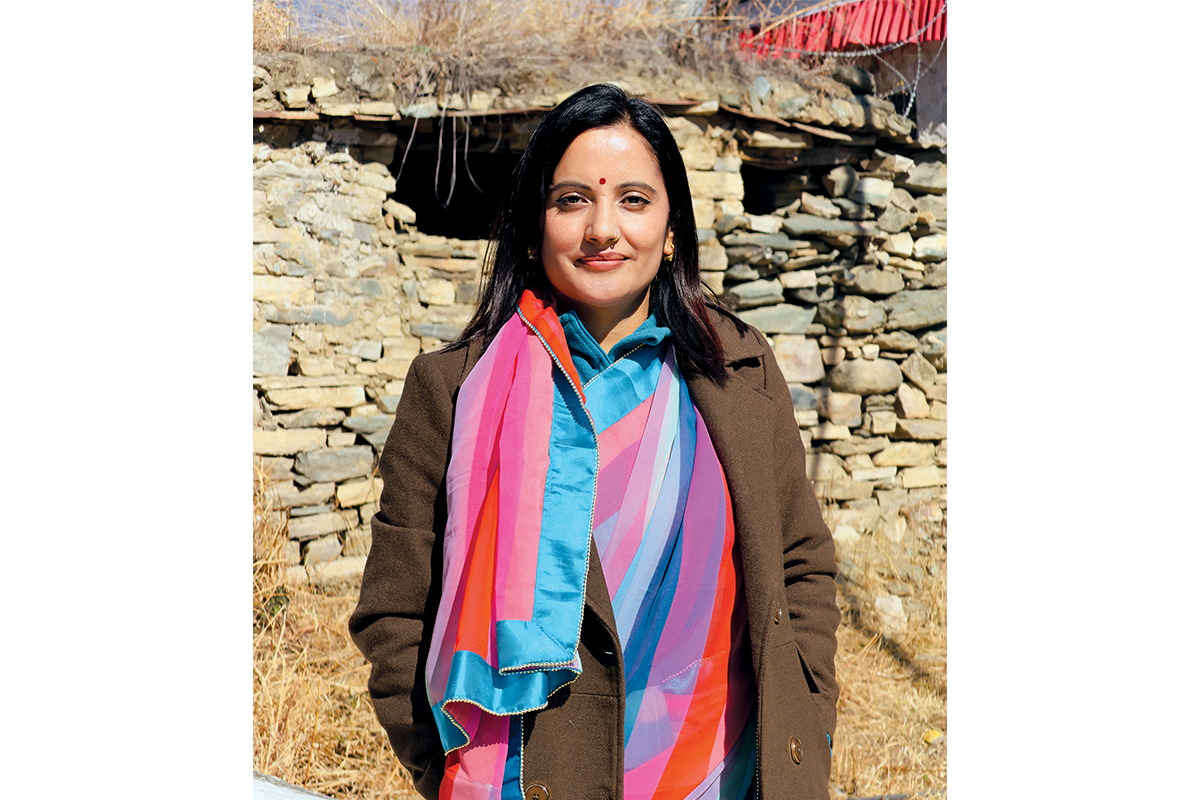
Junu Hamal Dhakal, Chief District Officer, Dolpa
Junu Hamal Dhakal made history as the first female Chief District Officer (CDO) of Dolpa, a remote part of Karnali. This achievement garnered attention across Nepal and was widely celebrated on social media. Beyond breaking a gender barrier, her appointment was notable for taking place in one of Nepal’s most isolated, high-altitude, and administratively challenging districts.
Dhakal prefers a simple, comfortable life, avoiding chaos and turbulence. She values calm, stability, and quiet routines over excitement or constant change. While it may seem uneventful to others, this simplicity brings her peace, balance, and a deep sense of contentment.
In this edition of Business 360, Dhakal shares five influences that have shaped her life.
A silent resilience to perform
In Nepal’s civil service, growth is earned, not given. Every promotion and posting is the result of years of persistence, countless Public Service Commission exams, and the willingness to keep going even when the path is unclear. Those exams, gruelling as they are, taught me something no classroom could - that life moves in cycles of struggle and breakthrough, and both are necessary.
Two months ago, one of those breakthroughs arrived. I was appointed Chief District Officer of Dolpa, and with it came a weight I had always wanted to carry.
The authority, responsibility, and sheer scale of the role had drawn me to public service since childhood. But nothing prepares you for the moment it becomes real. What made it more significant and more personal was the history attached to it. I am the first woman to hold the position of CDO in Dolpa, and the first woman from the five districts of the erstwhile Karnali zone to reach this role. That is not a small thing. It is a reminder that representation matters - that someone has to be first, and that being first carries its own quiet responsibility.
Then came the election, the largest logistical and administrative undertaking a CDO can face. To lead it in Dolpa, the largest district by area in Nepal, spread across some of the most remote and rugged terrain in the country, was both daunting and deeply meaningful. Roads that do not exist. Weather that does not negotiate. Communities that depend on the state showing up, often against all odds.
But I showed up as an administrator, a coordinator, a facilitator and a leader. And as a daughter of Karnali. That meant everything.
Legacy of a quietly fearless mother
Not all role models come with titles or accolades. Mine came with a calm mind, a fearless heart, and a personality that never took itself too seriously. My mother shaped me in ways I am still discovering, not through grand lessons or structured advice but through how she lived.
She was modern in her thinking, relaxed in her approach, and unbothered by what the world expected of her. She showed me that you can be carefree and responsible at the same time - that the two are not opposites. Watching her gave me clarity about the life I wanted: simple, grounded, productive, and on my own terms.
She is not highly educated, but that never stopped her from dreaming big or acting on those dreams with quiet confidence. She built an NGO, Naari Kalyan Kendra, from scratch. She ran it for years and earned genuine appreciation from marginalized women in Jumla. When the organization began to grow and people started exploiting it, she did not fight or spiral. She simply walked away with her integrity intact. That kind of clarity is rare.
She also wrote - stories, novels, and essays - without worrying about validation or literary circles. Some of her work was published, not because she chased recognition but because she believed in what she had to say.
The word I keep coming back to when I think of her is bindaas - carefree, authentic and quietly fearless. And somewhere along the way, I think that became me too: simple, a little bindaas, and deeply certain that this life is meant for something meaningful.
Wrong doors are as important as the right ones
I will be honest. I never wanted a difficult life. Not out of laziness but because I knew what made me happy: simplicity, comfort, and a life without unnecessary chaos.
My father had other plans. Based on my academic performance, he believed I was suited for MBBS. He pushed me toward science in 10+2, and I followed, though not without resistance. I even tried switching to humanities at one point, hoping for a different path, but it did not feel right. So I returned to science, quietly, on my own terms.
But MBBS was never going to happen. I knew that about myself. It demanded a level of relentless, lifelong intensity that did not align with the life I envisioned. So I made a deliberate choice and studied biochemistry instead, it felt like a fair middle ground.
Then came an unexpected opportunity: a scholarship for a Master’s and PhD programme in South Korea. I hesitated but went ahead with the process, curious enough to try. It did not take long to realize what it involved - late nights in the lab, gruelling schedules and pressure that followed you home. It was everything I had consciously been moving away from. So I walked away, even though it meant facing criticism from my college chief. That moment was not defeating, it was clarifying. If not research, if not medicine, then what?
The answer came quietly but firmly: government service. A path unrelated to my academic background, but deeply aligned with who I am - stable, purposeful and rooted in this country. Sometimes, the wrong doors matter just as much as the right ones.
Unshakeable integrity of a father’s quiet moral courage
If my mother gave me freedom, my father gave me a spine. He is a quiet man, simple in his needs and unshakeable in his principles.
Growing up, I watched him navigate a world that often rewarded shortcuts, and I watched him refuse every single one. He did things the right way, always, even when it cost him. And it did cost him. People wanted favors, expected rules to bend, and when he refused, it became personal. His character was questioned. He was called weak, accused of lacking the courage to take risks. But he never wavered.
That image stayed with me - a man so consistent in his integrity that it became indistinguishable from who he was. Not for recognition, not as a performance, but simply because he knew no other way to live.
It also made me see something clearly: many people exhaust themselves maintaining appearances, chasing a version of success that is only for show. Beneath it lies anxiety, compromise and a gradual loss of self.
My father showed me that the simpler path - the honest one - is also the lighter one. Alongside him, a few seniors in government service influenced me as well. Watching them work - the authority they held, the responsibility they carried for real people - resonated deeply.
I wanted to understand the system from within. I wanted to represent something - a woman from a marginalized region, from one of the least developed parts of an already developing country, choosing to show up and serve. That felt like enough reason to begin.
Bridging the global vision of ANU with the ground reality of Jumla
There is something quietly extraordinary about having lived at both ends of the spectrum.
I grew up in Jumla, one of the remotest places in Nepal, and by many measures, one of the remotest in the world. My early schooling was shaped by limited resources, vast distances, and a landscape as beautiful as it was unforgiving. It never felt like a disadvantage, it was simply life as I knew it.
Then came the Australian National University (ANU) in Canberra, one of the world’s leading institutions. A Master’s programme in public policy, and an environment operating at a completely different frequency. The infrastructure, intellectual culture, and diversity of thought - it was a world away from Jumla, both literally and figuratively.
But here is what I have learned: both experiences were necessary. Governance is not abstract, it lives in the gap between policy written in capitals and reality experienced in the last village at the end of an unpaved road. To serve well, you must understand both.
Jumla taught me the ground reality. ANU taught me to think beyond it. Together, they gave me a kind of double vision I do not take for granted, one that continues to shape how I think, decide, and lead.