Leading with Humility: Diwas Kumar Sapkota on Leadership, Innovation and Growth

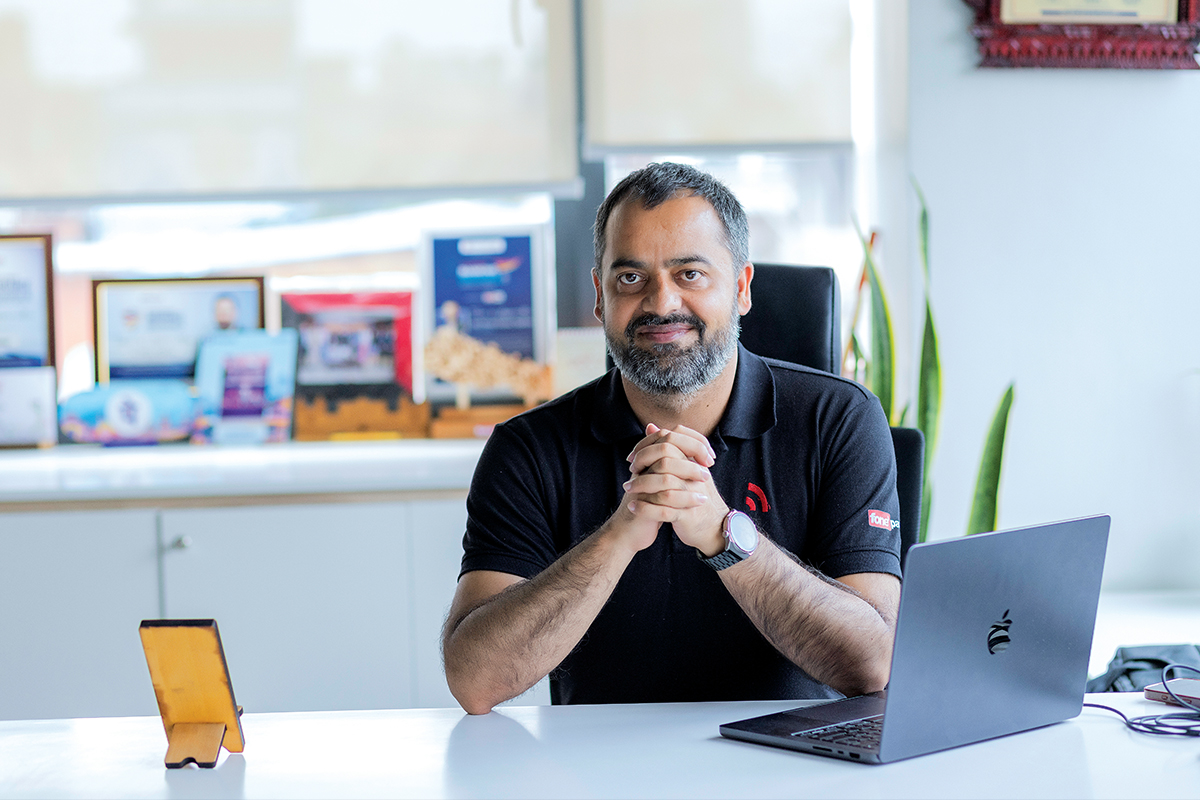
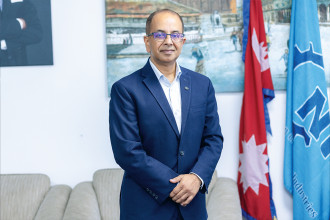
Diwas Kumar Sapkota, CEO, Fonepay
Some careers are meticulously planned. Others are shaped by timing, chance and a quiet willingness to say ‘why not’. Diwas Kumar Sapkota’s trajectory belongs firmly to the latter. Born in Gulmi and raised across India, where his father served in the army, Sapkota grew up navigating diverse environments. He completed his schooling and earned a Bachelor’s in Commerce in Shillong before returning to Nepal with a flexible roadmap: head back to India to pursue an MCA or an MBA in Bangalore, and build his future from there. Then, a friend happened to mention a vacancy at Everest Bank. The logic was simple enough. Apply, see what happens, and if it leads nowhere, stick to the original plan. It led somewhere. Joining the bank in 2007, he was placed in the IT department where he stayed for nearly a decade.
What followed was a non-linear, highly deliberate evolution. Sapkota completed an evening MBA while working full-time, then pursued an MSc in IT through distance learning to bridge the gap between his Commerce degree and his hands-on tech experience. This was not driven by corporate mandate but by personal initiative. He recognised the missing link and decided to fill it himself.
Following his tenure at Everest Bank, he spent two-and-a-half years at Nepal Clearing House Ltd before transitioning to Fonepay. Joining as CTO through established banking connections, he eventually advanced to Assistant CEO, and now serves as CEO, marking a decade of continuous growth with the company.
Outside the boardroom, Sapkota is someone who originally chose Commerce over Science in high school partly to safeguard his weekends for sports and the outdoors, a compromise he has never regretted. He travels, keeps a close eye on technological shifts, and by his own admission, speaks only when he has something meaningful to add. His leadership mirrors this exact philosophy. Quiet enough to listen and grounded enough to recognise that the best solutions rarely originate at the top.
In this edition of Business 360, Sapkota shares his core leadership philosophy, the unique challenges of the executive office, and the factors that keep him driven despite the hurdles. Excerpts:
How do you define your leadership philosophy?
When I think about leadership, I believe a leader should serve as a role model for everyone across the organisation. My perspective is that you need to empower people by giving them a certain level of autonomy and control. Leadership should never be centralised. Knowledge-wise, I do not pretend to know everything. There is a massive learning opportunity to be found in everyone around me. Every individual in the organisation brings their own unique experience and insights, and as a leader, it is my job to absorb those lessons too.
In our industry, the median age of the users we serve is around 24 to 25. Everyone’s values matter and you must recognise and respect those values. Today’s generation demands this even more. Recognition does not always have to mean promotions or salary increments. Sometimes, simply walking up to someone and saying ‘thank you’ is enough. Essentially, I believe in a humble approach rather than a strict, authoritative one. I believe in getting work done through humility.
Is leadership ‘inborn’ or ‘acquired’?
It is a mix of both. Certain traits need to be ‘inborn’ or at least shaped by your upbringing. How you were raised, whether you were naturally more vocal or quiet, carries an inherent quality.
But that does not mean you cannot cultivate those traits later. In my own case, I am naturally quite passive and reserved, not really a big talker. But when the role demands it, you find yourself speaking up and it eventually becomes a habit. So, while certain traits are inborn, others develop as you grow. I am completely fine talking about work. If it is work-related, I will speak as much as needed. But casual conversation just for the sake of it does not come naturally to me. Some people genuinely enjoy talking and find it fun. For me, it is more purposeful. That is the inborn part, I think.
-1782900619.jpg)
If your leadership were a strategy game, what would be your winning move?
The ability to read other people’s minds, knowing what they are thinking and what they will be thinking next. If you can anticipate that and act upon it, that is a pure winning strategy. In order to achieve this, experience plays a major part. And it is not about random people. It is about your colleagues, your competitors or whoever you are dealing with at any given moment.
You need to do your research on them beforehand. If it is a colleague, you learn how they think over time. If it is a bank or a client you are negotiating with, you should ideally understand them before you even sit down with them.
In a leadership position, understanding the true intention of the other party is everything. And even if you do not fully know them beforehand, when you meet them, you must perform a careful analysis. If you can do that, you have a winning strategy.
As the CEO of Fonepay, how do you keep your team motivated while drawing the line between pushing them out of their comfort zone and protecting their mental well-being?
The most fundamental thing is ensuring the team understands the core purpose like what we are working towards and the impact we are making on society and the economy. Once people truly grasp the purpose behind their work, motivation follows naturally. The problem is that when people work in silos, they often fail to see the bigger picture. Once you engrave that purpose in them, you barely need to motivate them separately.
In terms of uncertainty, within a technology environment, failures happen. When a team member makes a genuine effort and things still go wrong, you need to back them up. If people fear being blamed for failures, they will stop trying new things. And in this industry, a lack of initiative is far more damaging than a single failure. So, as a leader, you support them through genuine efforts, even when the outcome goes wrong. That said, in our context, which differs from, say, Western tech companies, I am actually more concerned about the opposite end: too much comfort. When you give people flexibility, they sometimes settle too deeply into that comfort zone. For me, the balance I watch more carefully is not whether we are pushing people too hard but whether we are letting them become too comfortable.
When you look at the goals on your desk for the next five years, what is the one leadership challenge that keeps you up at night?
The new workforce that is coming into this industry. I find them to be very bright and innovative thinkers, but increasingly casual, not so accountable, and not so responsible. There is a growing tendency toward short-termism. For an institution like ours that needs people you can rely on for the long run, finding those people is becoming harder. Dealing with this is probably my biggest challenge for the next four to five years.
How do you shift your leadership style from building a market to defending and expanding it when you no longer have a local blueprint to follow?
In today’s age, blueprints are important for behavioural and cultural values. But for products and markets, agility matters far more than any blueprint. The way you think, the way you see the market, the way you feel the customer’s pain. That is what drives you forward.
The ‘blueprint’ I care about is the one for values and mindset: how to build empathy, how to stay connected to the market. But a blueprint for ‘what the market will look like in five years?’
That does not really exist and even if it did, it would become outdated quickly. What matters is whether you can understand the pain of your market. Once you know that pain, you do not need a blueprint. You just need a plan for how to solve it. Agility, not rigidity, is the real competitive advantage here.
What is a deeply held belief or leadership principle you had early in your career that you have completely changed your mind about since becoming CEO?
When I was a student, there were certain subjects I used to wonder why we were studying them. For example, Indian Financial Systems, Political Business Environment and others. They just seemed irrelevant at the time. But when you reach this position, you realise how much impact a single line in a monetary policy or a fiscal policy can have on your business. I genuinely did not understand the importance of those things before. Now I sometimes wish I had internalised that earlier. It would have made things easier.
The other big one is managing people. When you are in the workforce, you do not fully appreciate how complex that is. But once you move into a managerial position, you realise it is a very tricky job that requires real skills. HR used to seem like a boring subject in school. Now I realise how directly relevant it is to everything I do.
Leaders are often expected to have all the answers but fintech moves faster than any single person can track. How do you practice intellectual humility as a CEO, and how do you ensure your team feels safe telling you when you are wrong?
The first thing is to remove the concept of ‘wrong or right’ altogether, at least when it comes to ideas and innovation. You can have a very absurd idea and you cannot judge it as wrong or right up front. If I do not judge other’s ideas that way, people will not feel afraid to challenge mine either. Everyone has their own perspective.
Operationally, yes. There are processes that are clearly right or wrong, and you need to call those out. But from a leadership and ideas perspective, I do not believe in top-down thinking. Ideas can come from anyone and often the best insights come from the ground up.
We also have what we call a ‘dai culture’ and no ‘sir’, regardless of seniority or age. Even our founders call me ‘dai’ even though I am younger than them. That culture fosters openness.
And I maintain an open-door policy. Nobody needs an appointment to talk to me. People can come, argue, question and disagree. However, productive arguments are welcome. You just need to have your own opinion and be able to express it. Whether it is ultimately right or wrong is a separate conversation. In fintech, no single person can have all the answers and you need everyone’s eyes on the market.
As you steer Fonepay toward going public, your role requires balancing the expectations of shareholders and board members with the creative freedom of your product teams. How do you shield your innovators from the rigid pressures of corporate governance?
Let me separate the two parts here. Compliance and governance are not IPO issues. They are corporate issues. Whether we go public or not, we need good governance. If we are not compliant, the company cannot grow. That is something I personally believe in.
That said, I do not think going public means our agility or innovation has to stop. Management’s role is to act as a bridge while protecting the team on one side and protecting shareholder interests on the other. The two should not bleed into each other. Staff concerns should not reach shareholders in a disruptive way and shareholder pressure should not distort the team’s focus.
Ultimately, both innovation and returns serve the same goal: growth. Revenue growth, growth in market size, growth in market value. An innovative company is a valuable company, for shareholders, for staff, for everyone. So, there is no real conflict if you approach it the right way. We are taking a five-to-ten-year growth outlook and that common goal holds everything together.
As global payment networks seamlessly integrate into Nepal, how do you prevent global tech giants from eventually overshadowing the domestic ecosystem you built?
Honestly, the dynamic has actually flipped. Five or six years ago, card payments in Nepal were dominated by Visa and MasterCard, and they had dominated this market for 25 to 30 years.
But today, Fonepay is a stronger domestic brand than either of them. It is actually the global players who are now figuring out how to integrate with us and do business through us. This is not unique to Nepal. In India, China and around the world, domestic payment systems have become so prominent that the global giants are losing ground domestically. They need us now as much as we need them.
Our strategy is not to shut them out. It is to leverage them smartly. They have far more resources, ideas and stable processes than we do. We can learn from them and that is part of our aspiration. But relationships are always two-way, so we give them room in our market too. The key advantage we hold is that we understand our market better than they ever will. That is our moat.
When should leaders hand over their leadership position?
There is actually a very relevant example right here at F1. The co-founders, who created this company, stepped out of executive and management roles at the right time. That is a rare and admirable example.
As for when to hand over, I think it comes down to two realisations: either the company is no longer adding value to you, or you are no longer adding value to the company. When either of those becomes true, that is the right time to leave. It is not about time served and it is not about legacy in the traditional sense. It is about what you are doing, the environment you are in, how you are treating people, how people are treating you. All of those matter. The triggering point can be anything.