Guarding Trust: Arya Joshi’s Mission to Build a Resilient Financial System

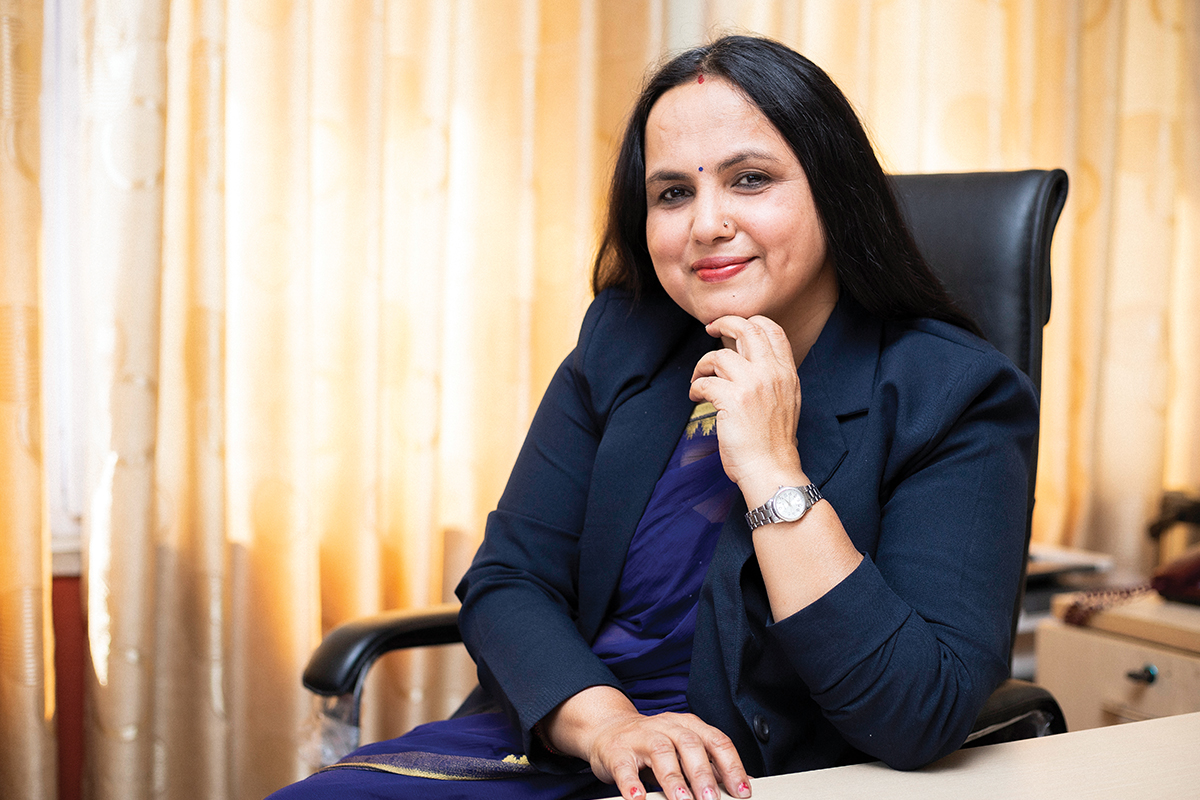
Arya Joshi, Director, Money Laundering Prevention Supervision Division, Nepal Rastra Bank
Arya Joshi serves as the Director of the Money Laundering Prevention Supervision Division (MLPSD), the unit responsible for safeguarding Nepal’s financial system from illicit money flows, at Nepal Rastra Bank.
Known among colleagues for her calm focus and sharp judgement, she has spent 20 years building expertise in financial regulation, risk assessment and compliance. Among her colleagues, Joshi is known as a thoughtful listener who values meaningful conversation and continuous learning. She believes that effective regulation is not only about rules but about trust in institutions and people. Her leadership style blends discipline with empathy, encouraging her team to approach complex challenges with both rigour and integrity.
In this edition of Business360, Joshi shares her leadership experience while being in a crucial position of a national regulatory body at the central bank of Nepal.
What does leadership mean to you?
Well, for me, leadership means a lot of things. But the primary leadership for me is an opportunity to break into the traditional archetypes. Because traditionally, the leadership or the role of leadership is very masculine, very aggressive and very command-dominated kind of a thing. And leadership, as of now, has given me an opportunity to show that leadership can be empathetic, it can be emotional and at the same time equally effective. So, for me, it is more of an opportunity to break the traditional archetypes.
Is leadership ‘acquired’ or ‘inborn’?
Well, I am a student of management. When we were doing our MBA and Bachelors, we were taught that leaders are either inborn or they are inculcated. It is always the nature versus nurture debate that we have been hearing for a very long time. I have been in Nepal Rastra Bank for 20 years. As you climb up the organisational hierarchy, as you pave your way to the top, you realise that leadership is a blend. Because there are some of the qualities that are inherent in one. And then there are some of the qualities that you have to imbibe and inculcate within yourself.
For example, you can be a very confident person and that gives you a solid foundation to start in your leadership journey. But things like conflict resolution, people management, these are the things you have to learn along your journey. And interestingly enough, there is another set of research that has actually fascinated me. And it is, I think, in the 1980s, there was this Centre for Creative Leadership. They had come up with the 70-20-10 rule of leadership, which says that 70% of leadership is basically the experience, 20% of leadership is something that you inculcate in yourself. For example, what you see. You might see your role modelled in a certain way, and that is how you learn, right? Seventy percent is your own experience. It is what you learn from your surroundings. And 10% is your education. Of late, I believe that the 70-20-10 rule is the best way to describe leadership.
When should a leader hand over their leadership position?
There are several reasons why someone might need to step down from a leadership role. In politics, leadership changes are often driven by elections and public choice. When voters support new leaders, the old ones must make way. In organisations, though, the reasons can be more personal or structural. For instance, if a leader is facing health issues, burnout or can no longer perform at their best, stepping aside is the responsible choice. Sometimes, roles are time-bound, especially in formal or legal settings, where leaders must leave once their terms end.
It also comes down to self-awareness. If your skills no longer match the demands of the role, or if you are no longer creating meaningful change and have settled into the status quo, it may be time to move on. Developing a sense of indispensability or arrogance can also harm the organisation. Good leaders avoid this by delegating authority regularly and preparing others to step up when needed.
If your leadership were a strategy, what would be your winning move?
Actually, I can have a lot of strategies because of the position I hold and the office I head. There could be a lot of strategies. Let us say that right now, in this position, my strategy is to be ‘a resilient architect’ because I have to contribute and do my best to ensure that our financial system is stable and resilient.
So, for the role I head, my biggest leadership strategy right now would be to act as a resilient architect. And, my winning move would be to collaborate, cooperate, bring everything around, everyone around, and do the best I can to create an ecosystem that is resilient, co-dependent, cooperative and collaborative.
How do you stay ahead of increasingly sophisticated financial crimes and ensure your team remains prepared?
In the world today, there are two ideas that I think enable any supervisor or regulator to stay ahead of the curve. The first thing is the ‘learning’ itself because I have to empower my team. I have to learn myself. I have to study myself. I have to keep myself abreast of all the happenings around the world, the contemporary issues that are threatening the Anti-Money Laundering and Countering the Financing of Terrorism (AML/CFT) landscape, not only in Nepal, but all over the world. And for that matter, I also need to ensure that my team is well-learned. They have this habit of learning and keeping themselves updated, and I also have to fight, and I also have to ensure that the institution and I myself put all the initiatives and efforts we can for capacity building.
-1780655547.jpg)
So, I think these are two factors when it comes to people. And I think in the future, we also need to leverage the use of technologies, super technologies, supervisory technologies, regulatory technologies. The future is also those.
Hence right now, I think it is individual learning, team learning and my own learning. And in the future, I think that needs to be an amalgamation of individual learning as well as technological leverage.
If you had complete autonomy, what is one reform you would implement immediately in Nepal’s anti-money laundering framework?
If you look at money laundering today, you really cannot fight a 21st-century problem with 20th-century tools. The nature of the threat has changed. It is everywhere, it is adaptive and it moves quickly. So, we have to rethink not just our methods but also where we invest our energy. One thing I feel quite strongly about is that our current AML/CFT approach is missing a very important group: young people. School students and college students are not really treated as stakeholders in this system but they should be. That is the age when values are shaped. If you explain to a 14-year-old that money laundering is a crime and why it matters, that understanding stays with them. Ten or 15 years later, you are less likely to see them on the wrong side of the system.
Right now, most of what we do is reactive. We have laws, we have technology and we investigate when something goes wrong. All of that is necessary but it comes into play after the damage is done. If we want a healthier system, we need to think more proactively. And for me, that means investing in young minds and building that awareness early on. Because the truth is, once people grow older, their mindset is already quite set. Changing that later becomes difficult and slow. But if you start early, you can create a real shift over time, not just at an individual level but across society. You can imagine a young person growing up with these values and even questioning things at home, telling their parents to use proper financial channels. That is how change spreads. Over time, it creates a society that follows the rules not just out of fear but because it genuinely believes in doing the right thing.
What are some hard truths about money laundering risks in Nepal that policymakers or the public often avoid confronting?
There are quite a few challenges but a couple stand out right away. The first is Nepal’s heavy reliance on remittances. That is the economic reality for a large part of the population. The issue is that when migrant workers send money through informal channels like hundi, they often get better rates than they would through formal banking systems. There have been efforts, like offering slightly higher interest rates on migrant deposits, but these incentives are still not strong enough. At the end of the day, unless sending money through official channels is just as affordable and convenient as informal ones, it will be very difficult to bring people into the formal system.
The second issue is something I mentioned earlier. We are still trying to deal with modern money laundering and terrorist financing risks using outdated, reactive approaches. Laws and enforcement tend to kick in after something has already gone wrong. What we really need is more investment in technology, especially in areas like IT systems and supervisory tools, so we can stay ahead rather than constantly catching up.
There is also a broader misunderstanding among the public. Many people assume that money laundering is mostly carried out by large criminal networks or international syndicates. But that is not always the case anymore. Increasingly, you see younger individuals, even school and college students, getting involved in activities like hundi, online scams or unregulated crypto trading.
This is where awareness becomes critical. As parents and as a society, we need to recognise that these activities can be happening much closer to home than we think. Sometimes it is happening quietly, behind a screen, even within our own households. Young people may not always realise the seriousness of what they are doing, and in some cases, they may be unknowingly used as intermediaries.
So, the challenge is not just about regulation. It is also about changing how people understand the issue, because money laundering today is not just distant or organised crime. It can be local, personal and much closer than we expect.
Have you ever had to make a decision that was legally correct but personally difficult? How did you navigate that tension?
Honestly, it comes up all the time, especially when dealing with money laundering cases. The Anti-Money Laundering Act is quite strict, and in most situations, it clearly requires you to impose monetary penalties once violations are identified. For example, during online supervision, when you uncover offences, the law expects you to follow through with sanctions. From a legal standpoint, there is not much room for flexibility. But then there is the human side of it, and that is where things get difficult. You are not just dealing with institutions in isolation. There may be people you know working there, sometimes even friends or relatives. That can make the situation uncomfortable.
In the beginning, I found this quite challenging. Over time, though, I have learned how to handle it better. One thing that helps is detaching myself mentally from the situation. I focus on the process and the facts, without thinking about who might be involved on a personal level. The second thing is depersonalising things. I remind myself that this is not about me or any individual. It is about doing what is right for the system as a whole. Once you start looking at it that way, it becomes easier to stay objective and deal with these situations more confidently.
What is the biggest misconception people have about the role of a regulator in financial crime prevention?
Oh, that is a tough one, honestly. It comes up a lot. Whenever I interact with people, there is this expectation that we act like investigators or detectives. And I usually have to clarify right away that that is not our role.
I often say, we are regulators, not investigators. Our job is not to go into banks and find out whether they have committed money laundering. That is the responsibility of law enforcement agencies. What we focus on is whether banks and financial institutions have strong systems in place. We look at their controls, their processes, and whether they are robust enough to reduce the risk of money laundering in the first place.
It is really about prevention. We want to make sure the financial system is sound, well monitored and not easily misused. In the same way, the sanctions we impose are regulatory, not criminal. They are meant to send a message. If there are gaps in oversight, there will be consequences, including financial ones. The idea is to encourage better compliance, not to punish in a criminal sense. But people often misunderstand this. They ask questions like how many banks we have investigated or criminalised. And I have to explain that this is not within our mandate. Investigations are handled by law enforcement, and ultimately, it is the judiciary that determines guilt and applies criminal penalties. Our role is much more focused. We assess whether systems are strong, resilient and capable of preventing misuse. That is where our responsibility begins and ends, even though many people assume it goes much further.
What personal values have you refused to compromise on, even when it may have slowed progress or created friction?
In this work, there is one value I have always held on to very firmly, and I have never compromised on it, and that is ethics. There are moments when temptations come up, or when the human factor and personal considerations start to weigh in. That is natural in any system where you are dealing with people and institutions. But I have made a clear decision for myself not to let that influence my judgement.
Of course, that choice has come with a cost. It may have affected some social interactions, and I may have lost a few friendships along the way. There could have been other opportunities or conveniences I had to let go of as well. But even with that, I have stayed firm on this principle.
For me, it comes back to the responsibility I carry in helping build a financial system that is stable and resilient. That responsibility demands consistency and trust. And I genuinely believe that integrity and ethics are non-negotiable in that process. Whether I am in this division or anywhere else in the future, those two things will remain absolute non-negotiables for me.
-1780655654.jpg)
What does accountability look like for you as a leader?
That really makes me think. For me, a big part of accountability is actually owning my own mistakes. Because if I expect others to come forward and take responsibility when they get something wrong, then I should be doing the same myself.
That applies in the workplace, especially in front of my team or seniors, where it really matters. If I have made a mistake in a decision or an adjustment, I should be able to go up and clearly say, “This is where I went wrong, and I take responsibility for it.” In fact, that is exactly what I expect from my peers and colleagues as well. So, it has to start with me. At its core, accountability for me is simply the ability to stand up and own my mistakes without hesitation. There have been instances of this, not so much in my current role, but definitely in previous jobs. And honestly, it is not limited to work. It happens in family life, too.
Sometimes, as a parent, you think you are doing the right thing for your children, and later you realise it was not the best approach. In those moments, you have to be able to go back and say, “I was wrong, you were right.” The same applies in relationships and with a spouse as well. I actually remember one incident at work. My team had gone for a field supervision exercise and they came back with a recommendation. I initially disagreed with them and overruled their view. But later that day, I kept thinking about it and realised their approach was actually better. So, the next day, I went back to them and said, “I am sorry, I was wrong. Let us go with your recommendation.” And honestly, that kind of thing happens more often than people think.
What is the loneliest part of being in a leadership position like yours and how do you deal with it?
Well, there are many moments in this kind of role where you do feel lonely and it comes in different forms. One is what I would call emotional isolation. People above you have certain expectations, even emotional ones, and at the same time, your colleagues and subordinates often see you as the person they can come to and vent everything to. You, thus, end up being the outlet for everyone else but you do not really have an outlet of your own. There are times when you want to talk, to process things, to just share what is going on, but there is no real space for that. That creates a kind of emotional loneliness.
Then there is what I would call the confidentiality trap. Sometimes you come across information that is extremely sensitive. Naturally, you want to discuss it, understand it better, think through the consequences or even just talk it out. But you simply cannot because of confidentiality. So, you are left carrying all of that internally, without being able to share it with anyone.
That can feel quite isolating as well. On top of that, even though I believe in collaborative and inclusive leadership, the reality is that this is a public institution with a clear hierarchy. No matter how open you try to be, the final responsibility for decisions rests with you. The yes or no, the right or wrong, ultimately comes from your desk. And that responsibility can feel very lonely because there is no one else who can really take that call with you.
Over time, I have learned to navigate this by shifting my perspective. I remind myself that it is not about me personally but about the institution and the larger purpose we are serving. That helps me accept the loneliness as part of the role rather than something personal. Outside of work, I try to keep a balance through family. I often share work situations as simple stories with my son and his responses are surprisingly insightful. He suggests simple things like talking to others, or finding safe spaces to share problems, even anonymously, through professional networks. Those conversations, along with family life in general, really help ground me. They remind me that work is only one part of life and family keeps me anchored.