
NRB unveils monetary policy for FY 2026/27, targets 7 pc growth

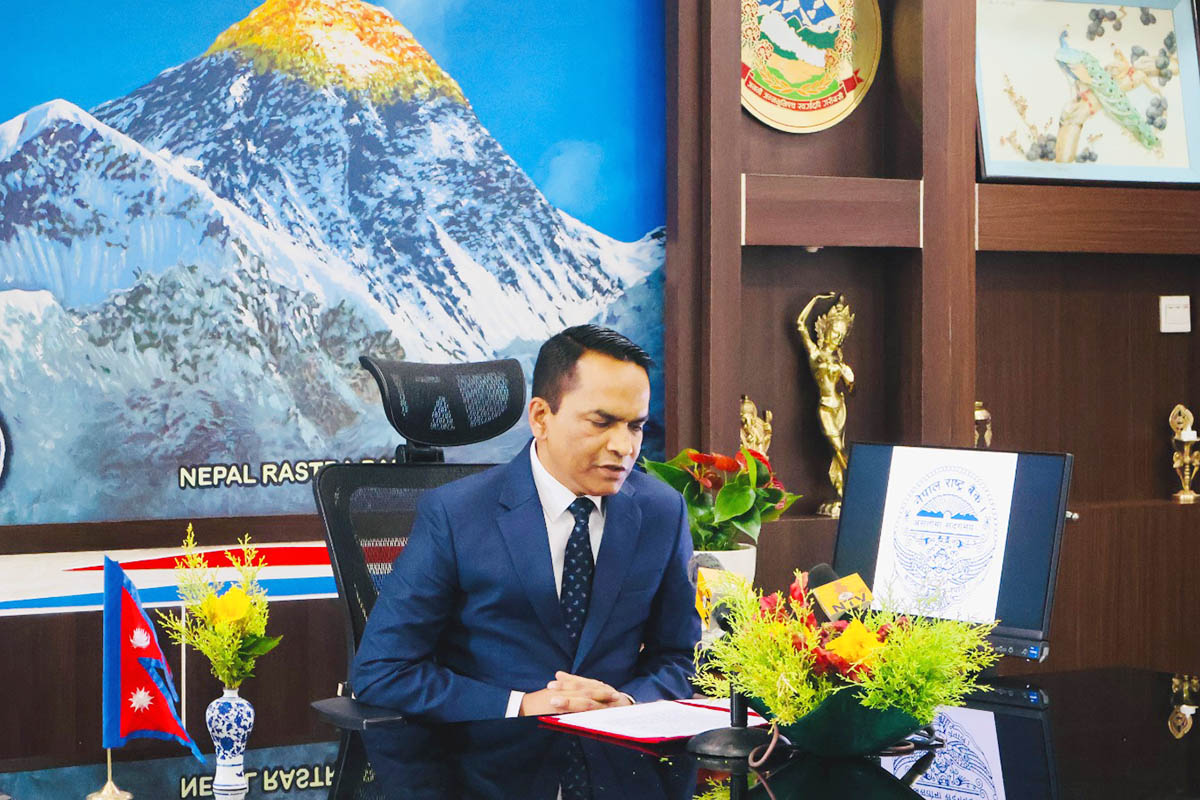
- Monetary policy vows close monitoring of vulnerable banks
KATHMANDU: Nepal Rastra Bank (NRB) has released its monetary policy for fiscal year 2026/27, targeting an economic growth rate of 7% while pledging close monitoring of vulnerable financial institutions under capital pressure. This is the 25th edition of the annual policy since the central bank began the practice in fiscal year 2002/03.
In a structural shift, the central bank has published the main monetary policy document separately from its regular macroeconomic report and from the previous year’s performance review. Economic Research Department of NRB separately released the Macroeconomic Report Analysis and Outlook, July 2026.
The central bank said global geopolitical tensions continue to cause supply‑chain disruptions, affecting international growth and inflation. Domestically, it said the country’s 7% growth target remains achievable if ongoing economic reform programmes improve the investment climate for private sector, if capital‑expenditure capacity is enhanced, and if external factors remain favourable.
Consumer inflation averaged 2.66% over the first 10 months of the current fiscal year and reached a year‑on‑year rate of 5.04% in April/May 2026. Although supply‑side pressures on petroleum and food are expected to persist for several months, the central bank projects inflation will remain within a 5.5% limit as conditions ease by the fourth quarter of the fiscal year.
The document places strong emphasis on financial stability, noting that while overall indicators are satisfactory, rising non‑performing loans have eroded the capital of some institutions. In response, those institutions will be subject to close monitoring.
To support a low‑cost economy and boost private sector’s morale, NRB has maintained a cautiously flexible policy stance. Key monetary rates, including the policy rate, the standing deposit facility rate and the bank rate, remain unchanged. Similarly, mandatory requirements such as the cash reserve ratio and the statutory liquidity ratio have been maintained at current levels.
The policy expects the current account and balance of payments to remain in surplus, supported by strong remittance inflows and tourism earnings, which should expand foreign exchange reserves to cover at least seven months of imports. To manage the liquidity generated by these foreign‑currency inflows, commercial banks will be encouraged to invest in foreign government bonds, and the central bank will introduce a policy for regular sterilised interventions.
The central bank also noted that the broader fiscal policy, which features public‑expenditure expansion and income‑tax cuts, is expected to stimulate aggregate demand and help absorb excess market liquidity.
Significant regulatory reliefs have been introduced to clean up credit lines. The central bank will implement provisions to remove unlimited liability arising from personal guarantees, manage non‑performing assets in distressed industries, and rehabilitate stressed loans. Steps will also be taken to reduce barriers to banking access for individuals blacklisted for cheque dishonour, and loan‑to‑value ratios will be relaxed for large electric vehicles used in public transport.
Additionally, the bank will simplify its unified circulars and rewrite core directives on loan flows, interest rates and financial consumer protection to remove linguistic complexities. A feasibility study will be conducted on peer‑to‑peer lending operations based on personal credit‑scoring systems.
The fixed exchange‑rate peg between the Nepali rupee and the Indian rupee remains the policy’s nominal anchor. However, tNRB cautioned that if inflationary pressures intensify or macro‑stability is threatened, it will review its flexible stance and may gradually narrow the interest‑rate corridor.
-1791630230.jpeg)
-1791623099.JPG)