Building Nepal’s Industrial Future: Birendra Raj Pandey on Leadership, Production and Change
I did not inherit this position or walk into an elite circle; I rose through the ranks myself, term by term, the same way every leader at CNI does. Institutionally, the 'small circle' perception is outdated. We now have province-level confederations across all seven provinces and district federations wherever industrial activity is strong, with over 7,000 members and growing. Yes, we were once known mainly for representing medium and large industries, and that is where the elite-club perception came from. That is not who we are today. Everything we advocate for is public, and we never push individual business interests, including my own, through the CNI platform. That distinction matters a lot to me: keeping the institution's voice separate from any personal or family interest. What I will say honestly is that our members represent close to 70% of private industrial sector revenue and practically all of the country's large industries but that is a reflection of economic weight, not exclusivity
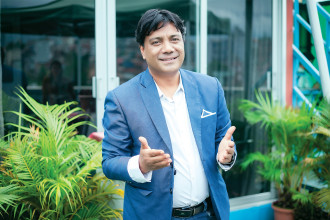
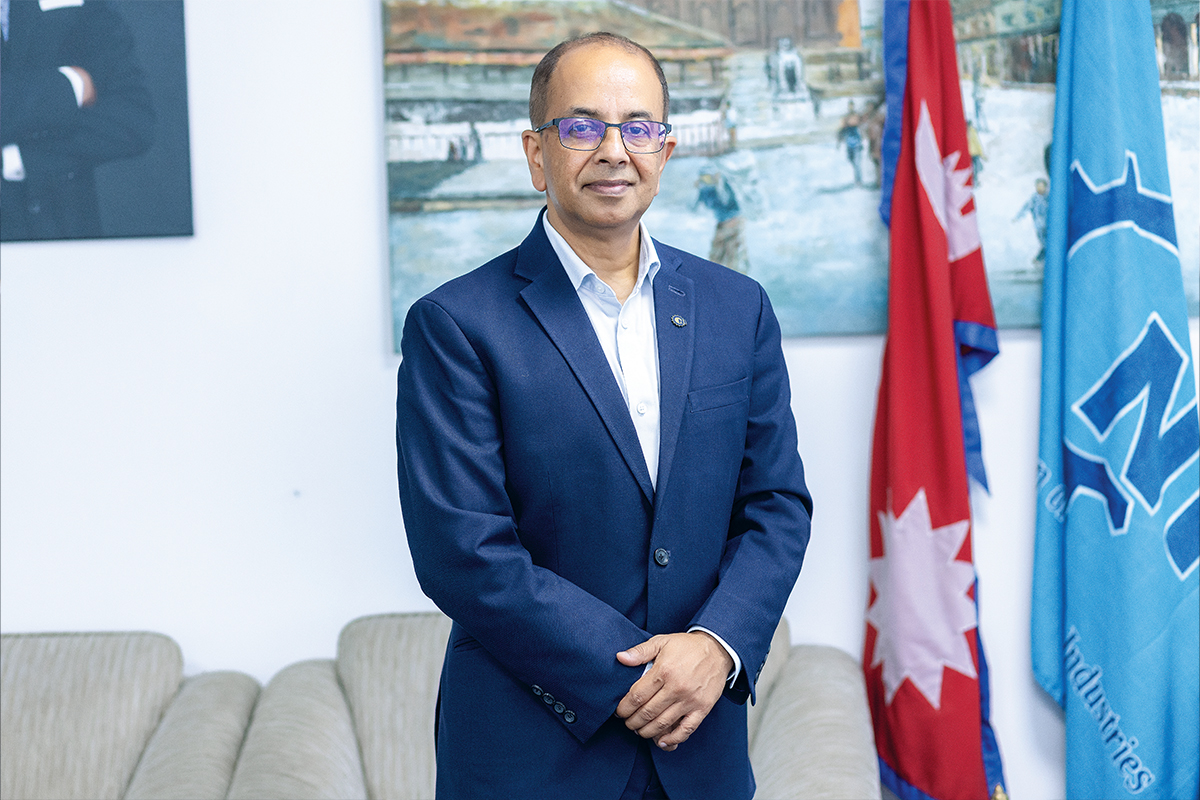
Birendra Raj Pandey
President, Confederation of Nepalese Industries
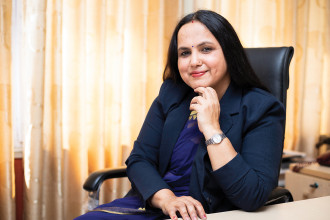
Birendra Raj Pandey leads the Confederation of Nepalese Industries the way he once approached a construction site: methodically, directly, with little patience for spin. Born into a modest family, he describes a career shaped less by ambition than by a conviction that private interests must yield to the greater good of the country and its industries.
That conviction was tested almost immediately. Pandey took over as CNI president barely two months before the unrest of September 2025, which destroyed several of Nepal’s largest industrial houses within days. The crisis of confidence that followed had him working closely with the interim government to expedite insurance claims, reassure investors and signal that Nepal remained open for business, a period he considers the defining test of his leadership.
Since then, CNI has expanded its national footprint while advancing a $100 billion economic vision. Pandey is unequivocal about Nepal’s most pressing crisis: youth migration, driven by an economy that has failed to generate opportunity at home. Reversing that outflow, he says, would count for more than any GDP figure recorded during his tenure.
Describing himself as ‘an open book’, Pandey brings a transparency that has come to define both his character and CNI’s institutional culture. In this edition of Business 360, he speaks about leadership, navigating uncertainty and the exodus of Nepal’s young.
What is your leadership philosophy?
Lead by example. If I want people to act a certain way or move in a certain direction, I have to do it myself first, before I ask it of them. Actions speak louder than words, and as a leader you are watched far more closely than you think. So instead of telling people what to do, I show them what it looks like. You do not point the way; you walk it first, so people can see it is possible and know exactly what is expected.
Is leadership acquired or inborn?
Both. Some of it is inborn - clarity of thought, for instance, is something I believe you are partly born with, even if it can be sharpened. And that clarity matters, because it feeds a long-term vision and the discipline to stay within it, which is one of the most important things a leader needs.
But most of leadership is acquired, and my own journey is proof of that. I was an introverted child, quiet and reserved, not the type you would peg as a leader. Over time that changed. I read, I observed how organisations worked, and my skills got sharpened. It is a lifelong process, and a strong propensity to learn is ultimately what shapes a good leader. Traits like clarity and vision you may start out with; ingenuity, and a certain simplicity in how you carry yourself, you build. All of it matters because it is what earns people’s trust, which is the foundation of leadership.
Could you share an incident that tested your leadership ability?
There have been a few, but the biggest came two months into my presidency, on September 9. Some of our own members - large industrial houses built over generations - watched everything reduced to ashes in a single day. For those directly affected, there was little anyone could say; it was simply too much to bear. But leading the industry meant steadying my own mind before I could console others. That was the real test: staying composed enough to act while everyone around me was reeling. Once the interim government was formed, we moved quickly, pushing for faster insurance claims and stronger reassurances for the private sector. They responded fast, and that cooperation helped restore confidence and bring things back toward normal.
If your leadership were a strategy, what would be your winning move?
I focus on the long term - where our industry is heading globally and within Nepal. There are several paths we could take, but the winning move is building a genuine culture of responsible business: one that takes environment, social responsibility and governance seriously, and leads the industry in that direction. That is where I am placing my bet - on sustainability and the circular economy because consumers are changing. They want to know how products are made, their carbon footprint, where raw materials come from. With IoT, that journey can now be traced. It is not easy here yet, but it is the direction we need to move in, and getting ahead of it early is what will set us apart.
When should leaders hand over their position?
When the term is up and someone else has earned their turn, not when personal preference says otherwise. At CNI we made a deliberate choice on this: leadership should be time-bound and performance-bound, not open-ended. We cut the executive committee’s term from three years to two, and every office bearer works against clear KPIs, with performance tracked against those goals. If you do not perform, you do not get re-elected. When your two years end, you hand over and move on, with the outgoing president staying on in a largely advisory role rather than clinging to the position. Leadership here is earned step by step, so the handover is never sudden. It is part of a progression that has already been building.
-1789375659.jpg)
In 30 years of construction, where did you make the wrong call and what did fixing it teach you that an MBA never could?
One incident stands out. I was project manager on a bridge in Sydney when a worker was injured: an idle excavator bucket fell and fractured his foot. Australia’s safety culture is extremely stringent and due process has to be followed to the letter. Legally, everything hinged on whether we had followed protocol. Fortunately, we had covered that exact hazard in the morning’s toolbox talk, warned everyone away from the machine, and had documented sign-offs, so inspectors confirmed we had complied. But the incident still stayed on our safety record, raising our premiums and affecting future contract chances.
What that taught me, and no MBA could, is that safety leadership is not about paperwork. It is about building a culture where every person on site internalises risk rather than ticking a compliance box. No process, however well documented, replaces that. In Nepal we still have a long way to go. We treat worker safety too casually, and the gap only shows once something goes wrong by which point the cost, human and otherwise, is already too high.
You have watched roads, bridges and water systems get built in Nepal, and get stuck for years. What is the biggest non-technical reason infrastructure leadership fails here?
I would challenge the premise that this is a technical problem at all. Our engineering has proven its strength. This building, and several other high-rises across Kathmandu, survived a 7.8-magnitude earthquake. Where infrastructure really gets stuck is the mindset that prioritised mere connectivity over quality. Historically, the goal was just to reach a place - dirt track first, gravel later, pitching after that - rather than build it right the first time. My own village road took 50 years to be properly paved. That is a cultural and political problem: tight budgets, cutthroat bidding, and design standards that were never treated as non-negotiable, because getting there mattered more than how well it was built.
Until that mindset shifts toward valuing quality as much as connectivity, infrastructure will keep getting stuck, not because we cannot engineer it well but because we do not demand that we do, from the start.
If a young engineer-turned-entrepreneur asked whether to spend the next decade building one great company or changing the system, what would you tell them?
Do not treat it as an either/or. Build your company and let contributing to the system happen alongside it, not instead of it. The system is always evolving, and both individuals and the country need people working to improve it, but that work does not have to come at the cost of building something of your own. In fact, I would tell a young engineer to lean toward building: be a job creator rather than a job seeker. Even creating employment for two people is meaningful, and that in itself is a contribution to the system. If you build well, you are already changing things around you - how work gets done, what standards look like, who gets opportunities. The strongest version of ‘changing the system’ usually comes from building something real first and letting your influence grow outward from there.
What is a sacrifice you made for this career that you have never said out loud, and was it worth it?
At a personal level, the sacrifice was staying with civil engineering when I had the chance to switch. In India, if you performed well in your first year, you could move to a different discipline, and I qualified. Civil engineering was not in demand then - computer engineering and electronics were the hot fields - and a friend who went with me made that switch. I stayed. It was not a dramatic decision at the time, just one exam result and one choice, but it quietly gave up the version of my life where I might have chased what was more in demand, more exciting, more forward-looking by the standards of that era.
Was it worth it? Yes, though I did not know it then. Civil engineering gave me a slower, steadier path, one that eventually let me build something real and lasting rather than chase whatever field was trending. I do not think I sacrificed opportunity so much as I gave up certainty; I could not have known at 20 how it would turn out. But looking back, staying the course was the right call.
Nepal’s industrial growth has lagged for decades. What has been missing - leadership, capital, policy, talent, something harder to name? And what is CNI’s role in changing that?
It is probably a million-dollar question we are still grappling with. But if I had to name it, I would say policy - specifically, policy that has favoured consumption over production. Development normally moves from agriculture to industry, with manufacturing reaching 25% to 30% of GDP before shifting toward services. Nepal de-industrialised too early; manufacturing fell from around 9% to below 5%, and the consequences have been serious: slower job creation, weaker domestic capital, import dependence, and young people pushed into migration instead of staying to build here.
Remittances ease things in the short term, but no country has become prosperous by exporting its workforce instead of its products. So, if I had to pick one thing that has been missing, it is the policy will to favour production. That is where CNI comes in. Our members have always been industrialists and service providers creating real domestic value, not traders, and our role going forward is to keep pushing that shift - through infrastructure summits, the ‘Make in Nepal’ campaign, support for young entrepreneurs and women, and stronger industry-academia partnerships, all tied together rather than treated as separate problems.
Where do you draw the line between what CNI can fix - investment, innovation, standards - and what genuinely depends on forces outside its reach like policy stability or global markets?
For me this is a leadership question at its core: knowing exactly which lever you are pulling at any given moment. Within our control are investment direction, innovation and standards - building the roadmap toward a hundred-billion-dollar economy, identifying which sectors and reforms matter, tracking automation and AI, partnering with universities, strengthening vocational training so our workforce can adapt. That is ours to own, and good leadership means owning it fully, not half-heartedly.
Outside our control are policy stability, global markets and geopolitical shocks - our dependence on India, fuel prices, the ripple effects of something like the Ukraine war.
We cannot fix those directly, and part of leadership maturity is admitting that plainly instead of pretending otherwise. But that does not mean staying passive either. CNI’s job is not to control those factors; it is to lead in a way that makes sure the government responds to them proactively, backed by real research rather than guesswork, so decisions get made faster and with better information. So, the line is not ‘what we can fix’ versus ‘what we ignore’. It is ‘what we build’ versus ‘what we push others to respond to well’. Being honest about which lever you are pulling, and pulling it with full conviction rather than spreading yourself thin, that, I think, is what leadership actually is.
Critics say CNI represents a small circle of established business families rather than Nepal’s broader private sector. How do you respond to the charge that you are managing an elite club, not an economy?
I would push back on that directly. Personally, I did not inherit this position or walk into an elite circle; I rose through the ranks myself, term by term, the same way every leader at CNI does. Institutionally, the ‘small circle’ perception is outdated. We now have province-level confederations across all seven provinces and district federations wherever industrial activity is strong, with over 7,000 members and growing. Yes, we were once known mainly for representing medium and large industries, and that is where the elite-club perception came from. That is not who we are today.
Everything we advocate for is public, and we never push individual business interests, including my own, through the CNI platform. That distinction matters a lot to me: keeping the institution’s voice separate from any personal or family interest. What I will say honestly is that our members represent close to 70% of private industrial sector revenue and practically all of the country’s large industries but that is a reflection of economic weight, not exclusivity. Leading CNI today means leading a national institution working for the economy as a whole, not managing a private club.
When two of your own members are in conflict, and both are right by their own logic, how do you decide who to stand behind — and what does that cost you?
When these conflicts come up, at district, provincial or central level, my approach is the same every time. I do not decide based on who is louder or more influential. I decide based on whether the outcome is win-win - not just for the two members involved, but for the country and the public too, through good quality products and services. If someone asks me to back something without real justification, or if it does not serve the broader welfare, I do not take it forward, regardless of who is asking or how strong their internal logic is. That is the line I hold, even when both sides genuinely believe they are right.
What it costs me personally is having to disappoint people I respect, sometimes people who have supported CNI for years, because standing behind the public interest instead of a member’s individual case is not always well received in the moment. But that is exactly what leadership requires here: holding a principle even when it is personally uncomfortable, rather than saying yes to whoever is easier.
When historians write about this era of Nepal’s private sector - not the GDP numbers, but the human story - what will they say leadership got right, and what do you already know they will say it got wrong?
If historians ask what leadership got wrong in this era, I already know the answer: we did not stop our young people from leaving. That is the biggest elephant in the room, and it happened on our watch, generation after generation choosing to leave for opportunity we could not offer them here. I will not pretend that is not a failure of leadership, mine included.
What I hope they will say we got right is that we saw the challenge clearly, faced it head-on and treated it as our core priority. We did not chase growth for its own sake; we built our boldest vision, a hundred-billion-dollar economy, around solving it. I would want it said that leadership understood the real goal was never GDP but creating enough hope and opportunity at home that leaving stopped being the only path forward, and that for those who did go abroad anyway, we still tried to make sure they left better equipped, earned more and remitted more, rather than treating migration as someone else’s problem to manage. If even a fraction of that reversal happens because of what this era of leadership pushed for, that would be the real measure of whether we got it right.